Treating NAVICULAR Syndrome without Horseshoes
(Thumbnail photo version for faster downloads; click on thumbnails to see full-sized photos.)
INTRODUCTION--Many people use the term "navicular syndrome" to refer to enlarged pathways for blood vessels in the navicular bone. These "lolli-pop lesions" may be more a result of high heels and tilted-down coffin bones. Some vets are finding there is not always a strict correlation between these enlarged passages, and pain. I personally use "navicular syndrome" to describe heel pain. Often this heel pain is the result of heel contraction and overgrown bars. Rather than immediately going for surgery, I feel it is much less invasive to try improved hoof form first. Trimming overgrown bars can often do some good, and is not a permanent change like tendon surgery.
A good trim relieves pressure in the navicular area caused by high, under-run heels and high--either folded over or impacted--bars. Lowering the bars, frogs, seats of corns and heels can result in rapid improvement.
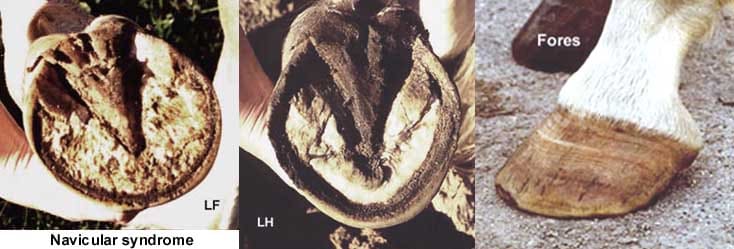
The photos below are of a gelding who was a remarkably gentle and quiet horse despite being quite young--probably because he was too sore to be otherwise. "Before" photos:
This horse's left fore had extremely high, under-run heels, and high, folded over bars. This jams up into the inside of the hoof capsule and puts pressure on the navicular area. Also, you can see that the ground place of the hoof is too far forward to be well under the leg, putting additional pressure on the navicular area. The bulged hairline shows that the lateral cartilages are being shoved up higher into the hoof capsule than they belong because there is excess heel and bar jamming up into the hoof from below.
Please also note that on the hind hoof, there is a raised ridge of hard bar horn growing so far forward that it is actually grown around the tip of the frog. This hard, lumpy tissue will feel like "rocks in your socks" to the horse. We want our trim to provide a uniform thickness of sole covering the coffin bone and following its contours. The juncture between the frog and sole should be the lowest point of concavity, not some area of the sole a ways away from the frog.
Finally, the excessive amount of horn in the heels and bars and seats of the corns (the small triangle of sole between the bar and outer wall) reduces heel expansion, and with it, concussion absorption. This also is uncomfortable for the horse.
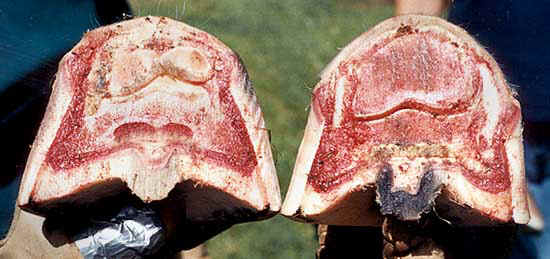
Cadaver cross-sections above showing a normal hoof on left, and a contracted hoof on right. Before the hoof on the right had been trimmed, there were high bars and heels jamming up into the hoof capsule, putting pressure on the navicular area, and inhibiting heel expansion and concussion absorption.
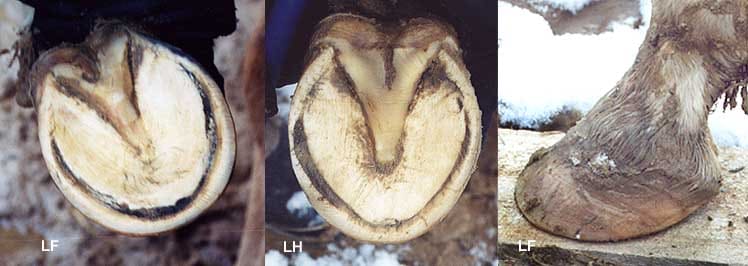
First attempt at a better trim. The heels, bars and frogs look good, but the toes are too long.
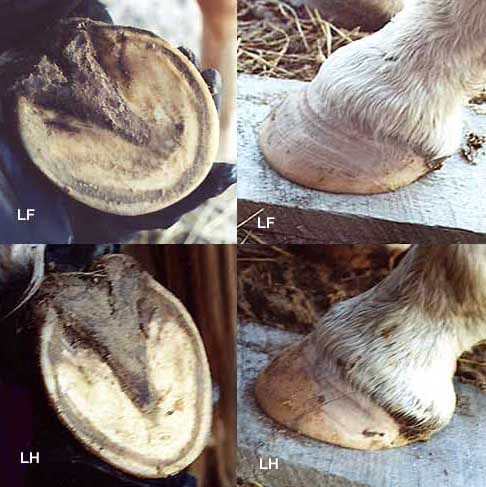
Second attempt at the trim--toe length better, but heels, frogs and bars need to come down a bit. The LF shows a good example of the moonsickle area being left in the toe area of the sole, which is good, although the moonsickle extends too far back on the inside. It should end opposite the tip of the frog, not go further back than this. The LH appears to have the sole not concaved all the way out to the white line in the inside quarter, as it should have.
Despite the trim still not being optimum, there was enough improvement that the owner reported being amazed at how much more active the horse was getting. This formerly quiet gelding was now galloping in the field of his own accord.
Thanks to Jennifer Schalk for permission to use these photos.
WHY reducing bars is key to getting at the root cause, heel pain--first, the corium (blood supply) is a delicate layer of tissue between the coffin bone and sole. The sole is softer and has some give to it, but overlaid bars are much harder. If bars are overlaid where they don't belong, over the sole in the bar/heel triangle and migrating forwards over the coffin bone, the corium is 'between a rock and a hard place.' Sole corium layer:
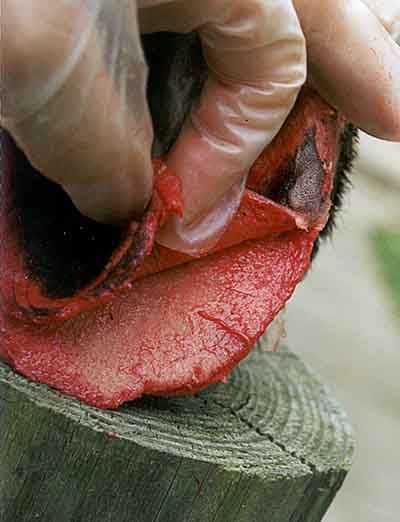
Delicate sole corium being lifted off coffin bone.
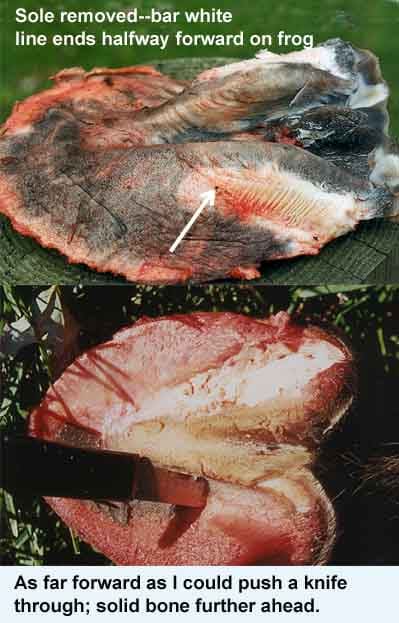
This shows WHY you want bars merging quickly with the
sole plane, no further forward
than halfway alongside the frog. This is where the bar white line ends. It is
also as far
forward as I could push a knife through softer tissue; further ahead, you hit solid bone,
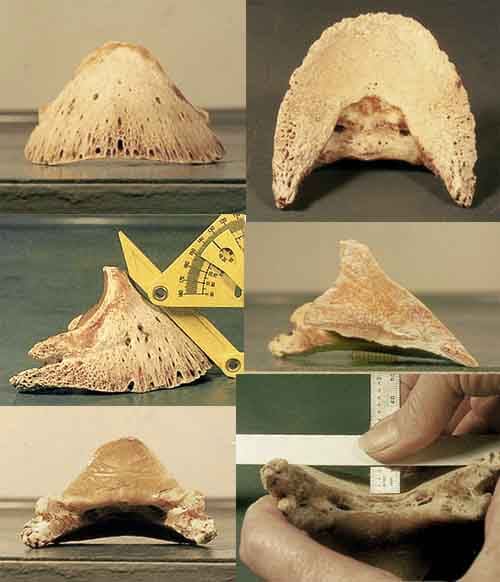
which is harder and more unyielding. Coffin bone views, below.
Ideal wild horse foot, left--note short, straight bars merging rapidly
with sole.

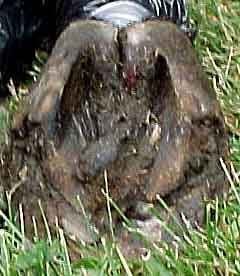
Next 3 photos--showing increasing degrees of bars getting overgrown and curved.
Please, don't judge these owners!
The more severe cases were animals who were recently rescued when I heard from their new owners. Unfortunately, not all these rescues came in time. Some were beyond help.
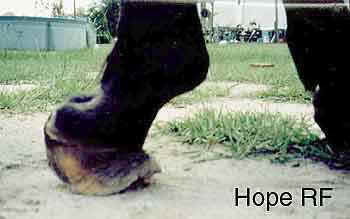
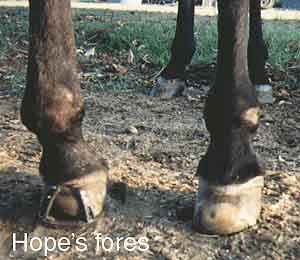
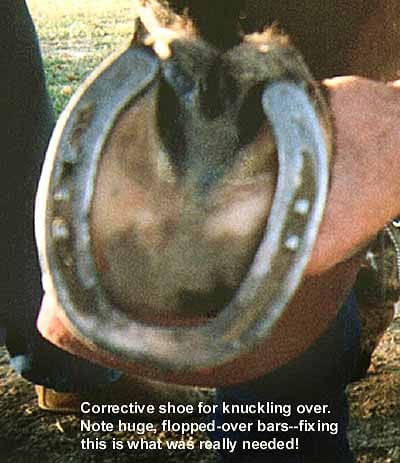
In extreme cases, heel pain can eventually lead to knuckled-over feet, which are more likely to have joint remodeling, rotation and coffin bone destruction. The horse below had a special shoe to prevent her walking on the fronts of her toe, which had limited success:
A common fix used for heel pain is a digital neurectomy ("nerving.") Don't do it! Please read Dr. Tomas Teskey's article on nerving, which also discusses the successful treatment of a navicular mare by improving her hoof form with better trimming.
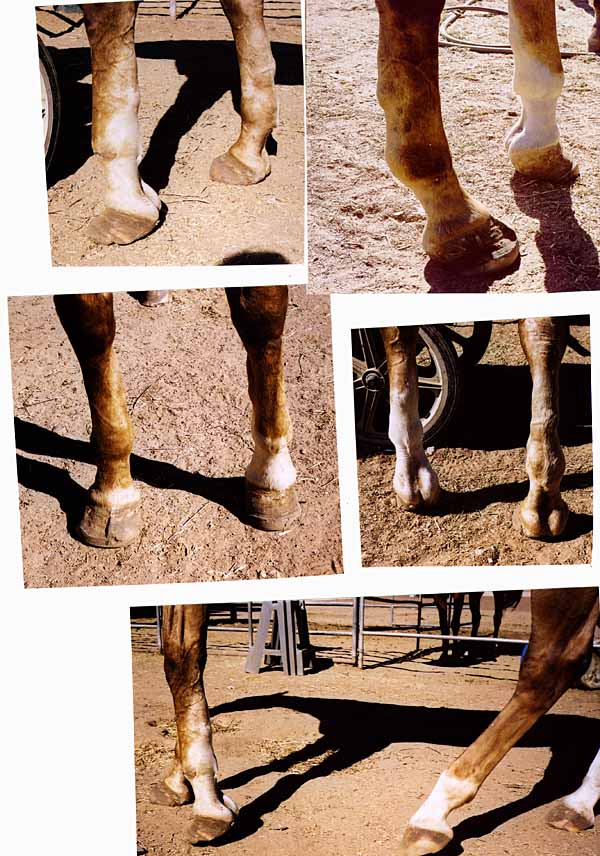
The next "solution" often advocated is a deep digital tenotomy. Once you lengthen the tendons a bit surgically, a horse intent on taking weight off his sore heels will just contract his forearm and shoulder muscles all the more in an effort to toe-walk and un-weight his heels. Tendon surgery often does not work well. Here is an 'after' photo of a horse who had the surgery--note lumps or scar tissue on the tendons:
I met a gray pony at a clinic who had also had tendon surgery to correct him being over at the knees. But nothing had been done about his overgrown bars. So after the surgery, he just tightened the muscles attached to his newly lengthened tendons, and was still standing with bent knees. Unfortunately I don't have photos. Still, these cases illustrate that even if the tendon can be made a little longer surgically, the horse can just contract his muscles all the more if he still wants to un-weight sore heels. To get at the root of the problem, you need to trim in a way that reduces heel pain.
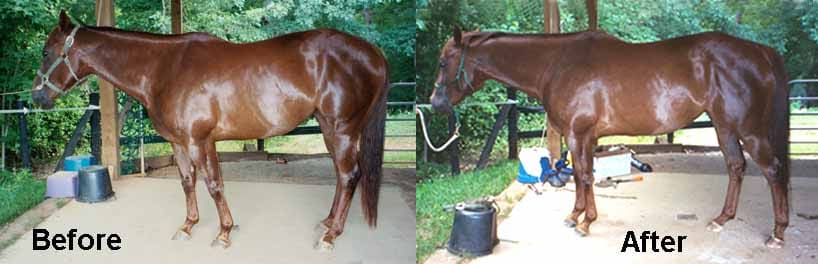
A navicular horse Sandy Judy worked on--see Barefoot success stories
This horse was not yet "over at the knee," or bending the
knees forward to reduce weight on her heels. She got pain relief from
standing under in the hind to shift more weight off the sore fores, plus
standing behind the vertical in the front to take some weight off her
heels. This is an early phase of navicular syndrome. If a horse is
"standing with its feet in a teacup," this is a red flag. Note
that her cannon bones are more vertical in the "After" photo.
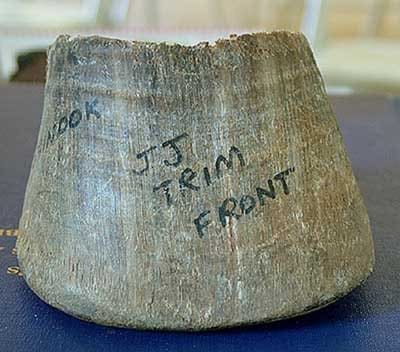
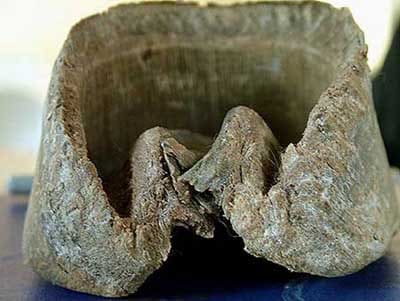

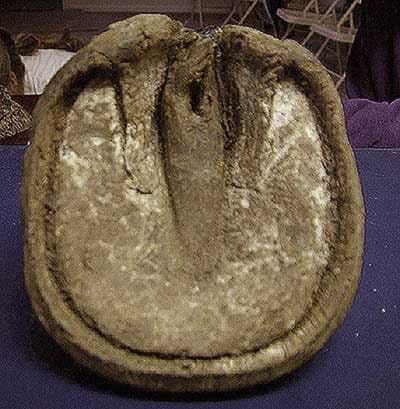

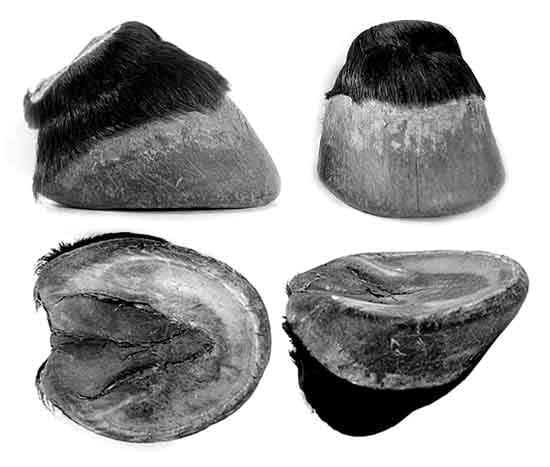
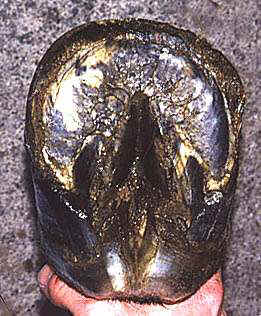
This hoof (above) has severe contraction and impacted bars. (Last photo is of a hoof capsule from the same collection, preserved via air drying the same way, that has bars considerably less impacted.) While some changes have resulted from this specimen drying out, its bars are still jammed up higher inside the hoof capsule than they should be, resulting in heel pain. Another outward sign of impacted bars are the bulged-up quarters in the side view. Heel pain leads to weighting the heels less, and the toes more. Toe-weighting leads to more heel contraction, heels growing faster than toes, "toe-walking," and rotation becomes more likely. Impacted bars are often a factor in navicular syndrome. This is why, when you trim impacted bars, they often 'come down' much faster than the rest of the hoof is growing, so for a while they may need to be trimmed very often until they don't come down faster than the rest of the hoof is growing. If you are not going to trim them as often, you may need to trim them lower than the sole. This is a more precision operation, and can easily result in hitting corium. You only trim directly over the bar, not to its side, which can be tricky, and is a more advanced technique not meant for beginners:
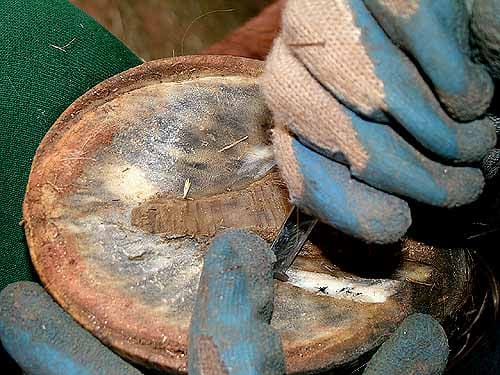
For most trimmers, just trimming the bars more frequently, but less drastically than in the photo above, is preferable.
Pete Ramey students seem to be advocating hardly ever trimming the bars, which is what Ramey's article on bars implies for the most part. They believe that bars practically covering the sole offer "comfort and support." I disagree, based on personal observation. We had a recent post on the naturalhorsetrim list about this issue:
Here in Florida, I see horse after horse whose bars have not been trimmed at all, some for years.  Many of them are dead lame trying to
keep their weight off those painful bars.  When I take the bar down passive to the sole, the horse straightens up and sighs with relief,
walking off sound.

I trimmed one young TB who had been at a large warmblood training facility. He was shod and became very lame.  The vet diagnosed him
with navicular and recommended euthanasia.  The owners placed him with a rescue as a temporary resident to see what they could do.
They had the shoes pulled and called me.  His first trim, he could barely stand on any foot, which made trimming a real challenge.  It
turned out his bars were laid over his entire sole - becoming what they call a "false sole."  He was in a lot of pain.  I could lift the
bars up with my knife at the wall and peel them up.  I trimmed them passive and shaped up the rest of the hoof.  He was completely sound,
comfortable and easy to trim the next time I saw him.  Owners reclaimed him after a couple of months and I never saw him again.

Navicular has become a catch-all term for heel pain.  Since there can be many reasons for heel pain, it stands to reason the bars may not
be the culprit in all cases.  A local "sports specialist" vet claims there are "31 different types of navicular."  I would love to see the
list and explanation of the different types - pop quiz time! LOL
Unfortunately, this horse was in so much pain the first time I saw him that I could barely trim him, much less get photos. And, after one trim, his
feet looked so normal there didn't seem any point in pix. His name was Cyrus, and you are welcome to use the story on your website.
Interestingly, his sole wasn't bad under the bars. It wasn't the
creamy white stuff now termed "live" sole, but it wasn't nasty, either.
The
other horse I have trimmed with major false soles was a founder.
His feet were a mess, but he still had soles under those bars.
The
place where I see very thin, choked out sole is next to a bar that is
overlaid but not spread way out. Those bars are usually more solid
and press down on the sole, I have to be careful trimming it off
or the horse will bleed, although it rarely makes them sore if that
happens. The false sole bars are so thin they are almost like parchment and can be peeled up off the sole with your fingers, but tough enough that you have to use a knife to cut them off. Anne Daimler HHP
DeLand, FL
|
Here is a recently rescued donkey whose stance shows heel pain in the fores leading to being "over at the knee":

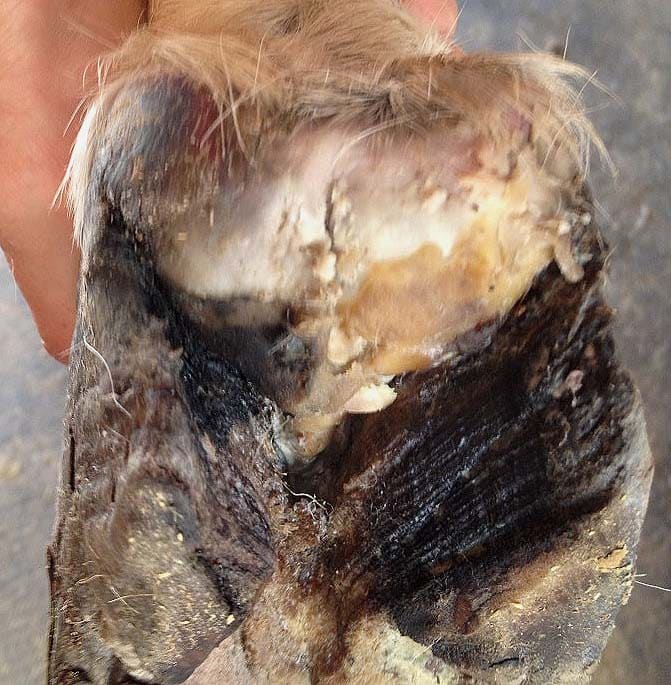
The hoof form shows very high heels and bars. The new owner was trying some topical treatments for thrush, but the hoof form needs to be improved before progress can be made with the frogs. Heels and bars and overall hoof length need to come down so the frog actually can engage with the ground enough to improve circulation, and hoof form becomes more self-cleaning. An added benefit would be the reduction of heel pain.
The donkey is bending her knees forward to take some weight off her sore heels.

| Among the potential
long-term complications of navicular:
1. Over-weighting the toe, in an attempt to relieve heel pain, can make it more likely that a horse can founder. 2. A long-term stance of the coffin bone being pointed down in the toe can result in consideration coffin bone damage and erosion. 3. The fetlock joint can become so arthritic and eroded that it will fuse. |
Stally, a horse with these severe long-term changes:
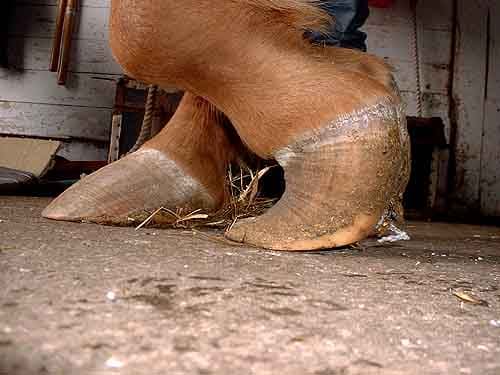
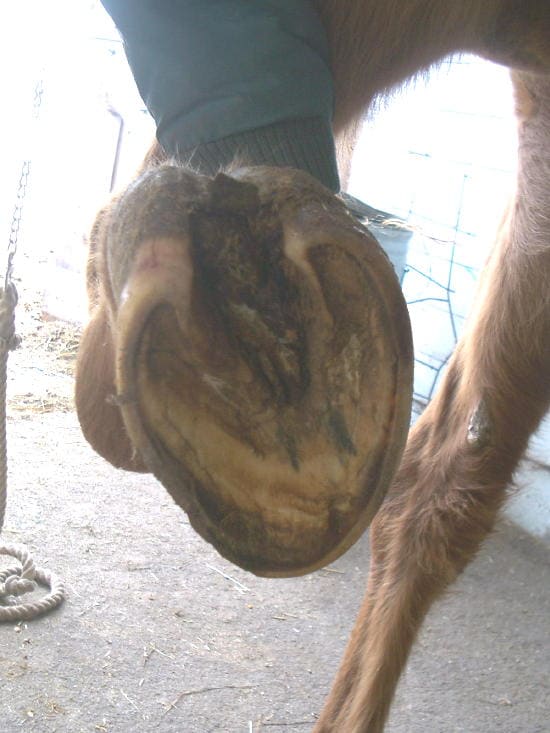
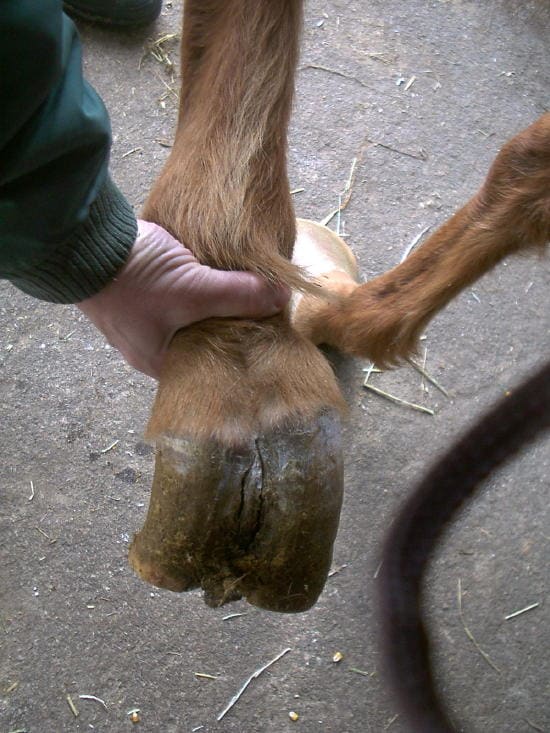
Note heel contraction, and overgrown bars--the sources of heel pain.
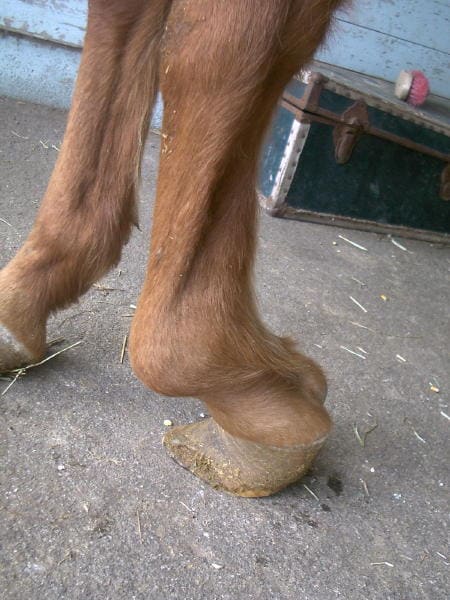
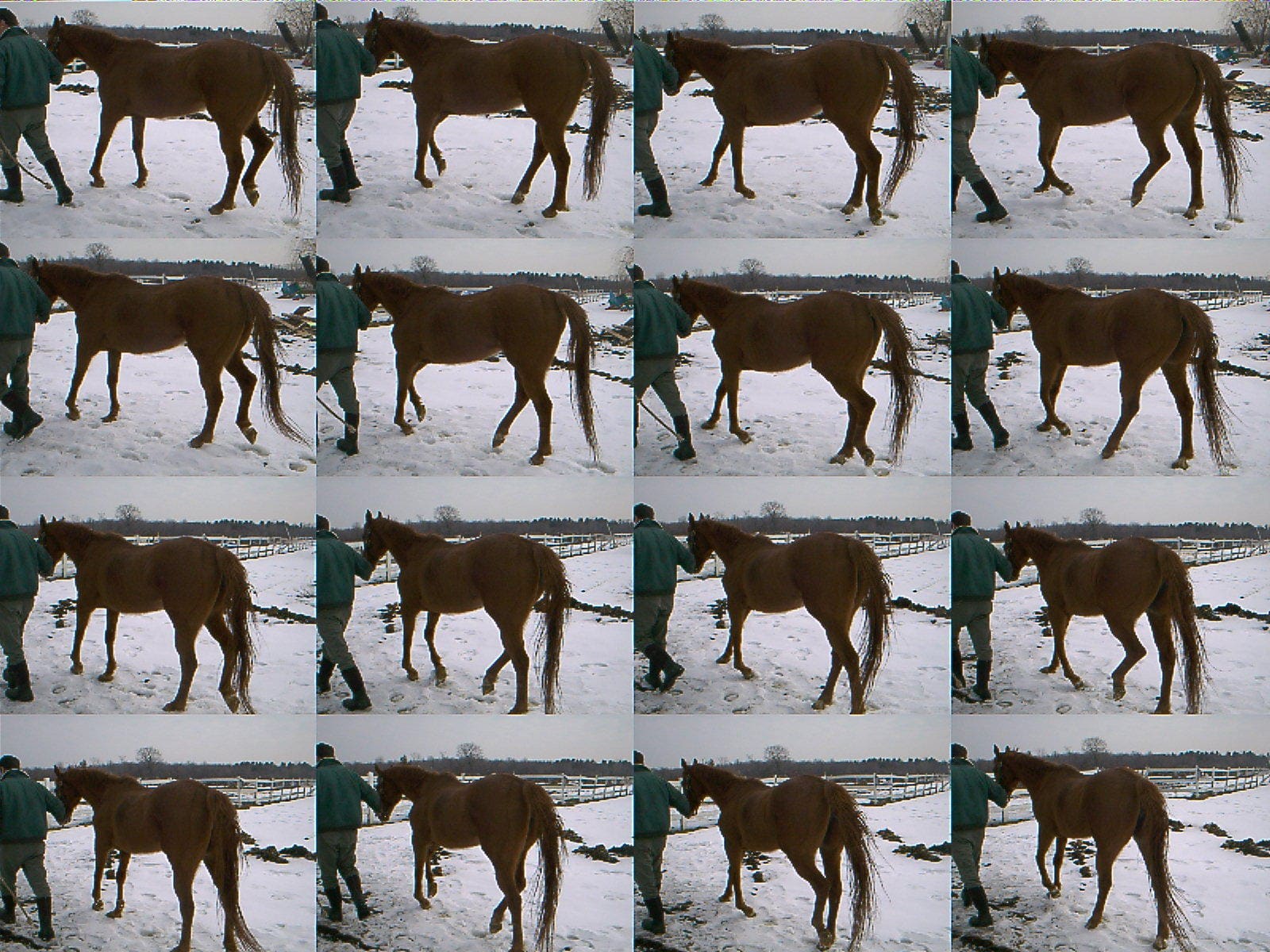
How she walked:
The trimmer attempted to take off some excess, but noted that the fetlock could not be moved. The owners elected euthanasia. Post-mortem, her left fore was dissected. Her fetlock joint was completely fused. The coffin bone was greatly eroded and at least half gone.
Navicular No More, Click here Far from being a hopeless condition, often "navicular" can be healed with correct hoof form.
Back to home page--Table of Contents
Article in sections with "thumbnail" photos
for fastest
downloads:
1
9
17
2 10
18
3 11
19
4
12 20
5
13 21
6
14
22
7
15
23
8
16 24
NAVICULAR
Article in sections with full-sized photos
for print-outs:
1
9
17
2 10
18
3 11
19
4
12 20
5
13 21
6
14
22
7
15
23
8
16 24
NAVICULAR
To Strasser case
studies--thumbnail photos for
faster
downloads
To
Strasser case studies--large photos
Please sign my
guest book!
Photos of my pets
My farm
Share
Barefoot success
stories on this page
Buy or sell used
HORSE BOOTS Natural board
Barn Listings

Click here to subscribe to naturalhorsetrim
(I strictly moderate this listserv to weed out "fluff.")
Send Email to Gretchen Fathauer, or call (740) 674-4492
Copyright by Gretchen Fathauer, 2013. All rights reserved.